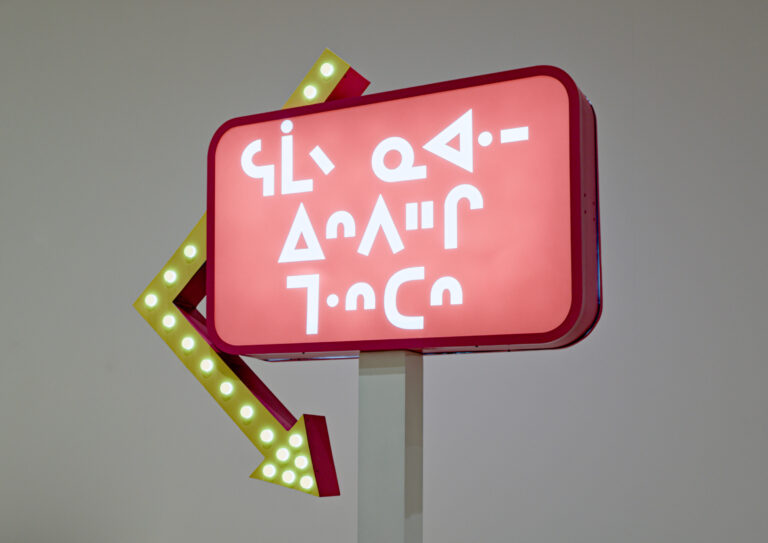
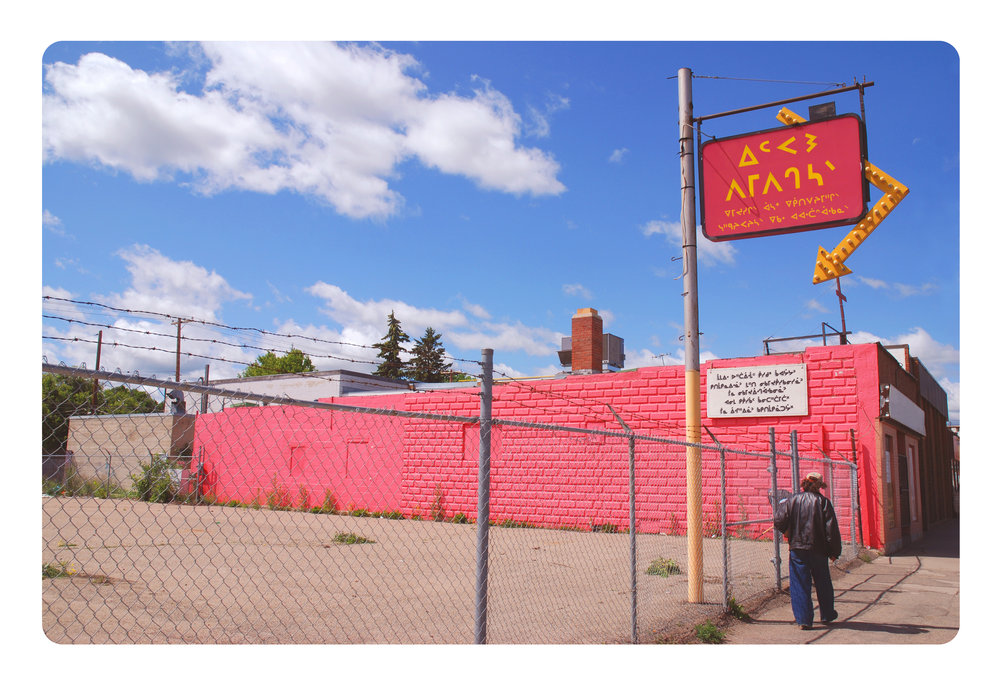
Arcand reclaims nēhiyawēwin, a language she has been learning her whole life, and asserts its intellectual, aesthetic and cultural sovereignty and manifests its power to shape worlds.
ᑳᐃᓯᓈᑿᐦᑭ ᐃᑘᐏᓇ kā-isinākwahki itwēwina: The Shape of Words is Joi T. Arcand’s first major solo exhibition in Ottawa, and her largest to date. Arcand is an internationally renowned nēhiyaw (Plains Cree) contemporary artist from Muskeg Lake Cree Nation in Saskatchewan, who has made Ottawa her home for the past decade. Since 2009, ᒐᐦᑭᐯᐦᐃᑲᓇ / cahkipēhikana (Cree syllabics) have been central to Arcand’s extraordinary work in photography, installation, sculpture and design.
Furthering concepts in the photograph series Here on Future Earth (2009) where Arcand Photoshopped ᓀᐦᐃᔭᐍᐏᐣ / nēhiyawēwin (Plains Cree language) to replace English on signs in Cree territories in Saskatchewan, Arcand’s radical vision for this exhibition is to create an immersive ᓀᐦᐃᔭᐍᐏᐣ utopia.
Arcand’s Here on Future Earth series sets the stage for glowing signs featuring ᓀᐦᐃᔭᐍᐏᐣ phrases, which beckon us with illuminated messages. New works, including murals and sculptures, featuring a collaboration with Anishinaabe artist Cedar Eve, transform the gallery into an urban ᓀᐦᐃᔭᐍᐏᐣ environment. Two billboards, in the nearby Little Italy neighbourhood, will feature new work created in collaboration with Dani Printup and Cedar Eve, extending the exhibition beyond CUAG’s walls.
The exhibition advances Arcand’s exploration of key themes: visibility, untranslatability, reclamation and revitalization. Her work involves extensive research in linguistics, morphology and translation. Arcand reclaims nēhiyawēwin, a language she has been working at learning her whole life, and asserts its intellectual, aesthetic and cultural sovereignty and manifests its power to shape worlds.
Arcand champions the power of language to build worlds, and the power of nēhiyaw cultural knowledge expressed in the shapes of ᓀᐦᐃᔭᐍᐏᐣ to strengthen cultural identity. Smart-phone enabled videos will enable visitors to see and hear the pronunciation of ᓀᐦᐃᔭᐍᐏᐣ words as they appear in artworks, while an interactive vintage payphone will offer the opportunity for visitors to receive messages spoken in nēhiyawēwin.
Programming accompanying the exhibition will publicly ground Arcand’s pioneering work in nēhiyaw worldviews.
Joi T. Arcand is an internationally renowned nēhiyaw contemporary artist from Muskeg Lake Cree Nation, Saskatchewan, Treaty 6 Territory. She has lived in Ottawa on the traditional, unceded territory of the Algonquin Anishinaabe peoples for over a decade. Her practice is characterised by a visionary and subversive reclamation and indigenization of public spaces through using nēhiyawēwin and cahkipēhikana. She holds a BFA from the University of Saskatchewan and a Bachelor of Arts in nēhhiyawēwin studies from University nuhelot’jne thaiyots’ nistameyimākanak Blue Quills.
Arcand was shortlisted for the prestigious Sobey Art Award in 2018. Her participation in international exhibitions such as Àbadakone at the National Gallery of Canada, National Gallery of Victoria Triennial in Australia and Singing Mother Earth at the Busan Museum of Contemporary Art, Korea has established her as a significant figure within the larger contemporary art landscape. Arcand’s work has been the focus of solo exhibitions at venues including the Mackenzie Art Gallery in Regina, SK; Central Art Garage in Ottawa; College Art Galleries in Saskatoon. In 2024, Arcand received the Ohpinamake Award for Indigenous artists. In nēhiyawēwin ohpinamake means “to lift others.”
Curated by
Heather Anderson with Cara Tierney
Artists in the exhibition
Joi T. Arcand
Cedar Eve
Credits
Carleton University Art Gallery is grateful for the generous support of the Terra Foundation for American Art in realizing this exhibition.
The Terra Foundation for American Art expands narratives of American art through its grants, collection and initiatives. With offices in Chicago and Paris, the Terra Foundation works with organizations to foster intercultural dialogues and encourage transformative practices, locally and globally.

CUAG also thanks the Canada Council for the Arts and the Ontario Arts Council for their support of this exhibition.
We are also grateful to the Banff Centre for the Arts and Creativity, SK Arts, Winnipeg Art Gallery, Central Art Garage and Danny Hussey and Bridget Thompson for loaning works to the exhibition. Additionally, the exhibition features an artwork purchased with the support of the Elizabeth L. Gordon Art Program, a program of the Gordon Foundation and administered by the Ontario Arts Foundation.
Special appreciation goes to Artengine for their technical expertise and collaboration.