Threading Roots considers how identity is continually made and remade through cultural practice, family histories and acts of remembrance.
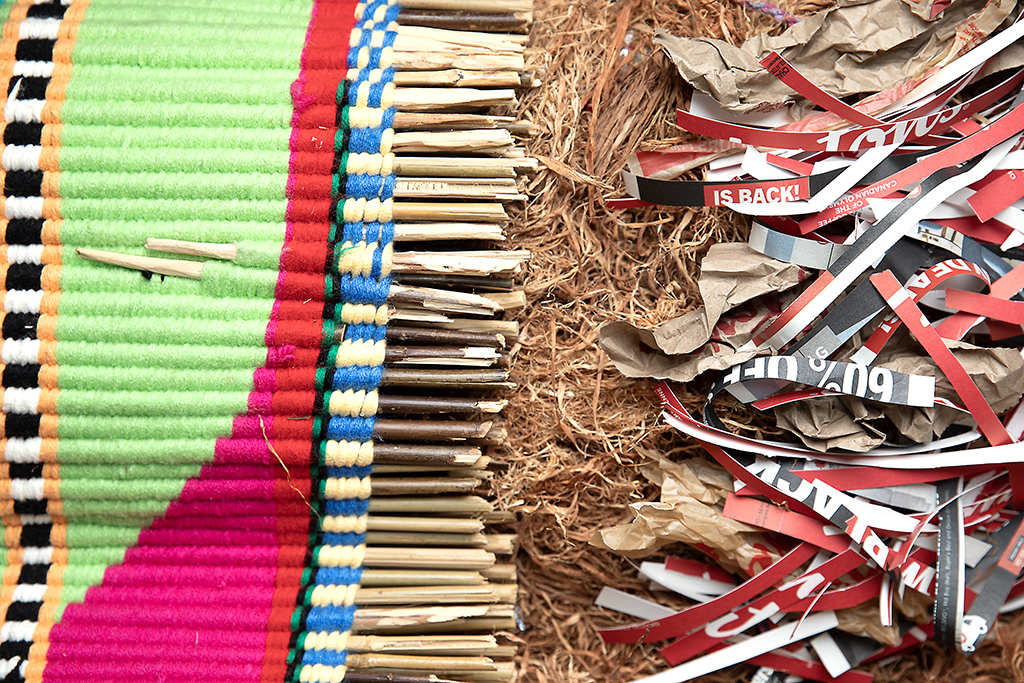
Moving between family archives and studio portraiture, Threading Roots invites viewers to consider how identity is woven across memory, place, and generations. Somali Canadian artist Faisa Omer uses photography, and textile to reflect on the enduring connections between family history, cultural inheritance and belonging. Enlisting her family in the development of this exhibition, Faisa Omer anchors her creative practice relationally. Through a site-specific textile installation and her sustained attention to fabric and fashion, this exhibition explores how textiles—through their movement across space, proximity to the body, and role as a means of economic survival—carry cultural knowledge and enable everyday acts of self-expression.
Responding to her experience as a racialized individual, Omer creates portraits that offer space for nuanced expressions of self that emerge through lived experience, memory and community, challenging dominant representations of Somali identity while affirming the richness and complexity of diasporic life. Challenging historic portrait/sitter photographic relations and informed by her work as a mental health counsellor, where listening, empathy and care shape her relationships with the people she photographs, Omer’s portrait’s speak of trust, agency and the safety to reveal intimate psychological presence.
Bringing together carefully composed photographs with material references to Somali textiles and dress, Threading Roots considers how identity is continually made and remade through cultural practice, family histories and acts of remembrance. The exhibition celebrates the creativity, resilience and cultural continuity that sustain Somali Canadian communities while reflecting on the ways home can be carried across distance, generations and time.
The exhibition intro text is available as a PDF in English and Somali.
Faisa Omer is a portrait photographer as well as the Counsellor for Racialized Students in Residence at Carleton University. Her educational background includes a bachelor’s and a master’s in neuroscience from Carleton University as well as a second master’s in counselling psychology from Yorkville University. Faisa also learned the technical aspects of studio photography at Algonquin College. Her work has been shown at the Ottawa Art Gallery, the Art Gallery of Alberta, the Soomaal House of Art and is owned by two Canadian mayors.
Reyhab Mohmed Patel is a PhD candidate in sociology at Carleton University, scholar-artist and curator whose work investigates Muslim creative practices, cultural memory, identity and belonging. Through her curatorial and artistic practice, Patel explores how photography, fashion, textiles, and material culture can preserve, reinterpret, and reimagine diasporic histories.
Curated by
Reyhab Mohmed Patel
Artists in the exhibition
Faisa Omer
Credits
Special thanks to
Khayrhaye Somali Cultural Museum Centre
Supported by the Joe Friday and Grant Jameson Contemporary Art Fund